

Glass Greenhouses: Ultimate Guide for Bulk Buyers
A glass greenhouse is still one of the most attractive products in the garden greenhouse category. It offers a premium…
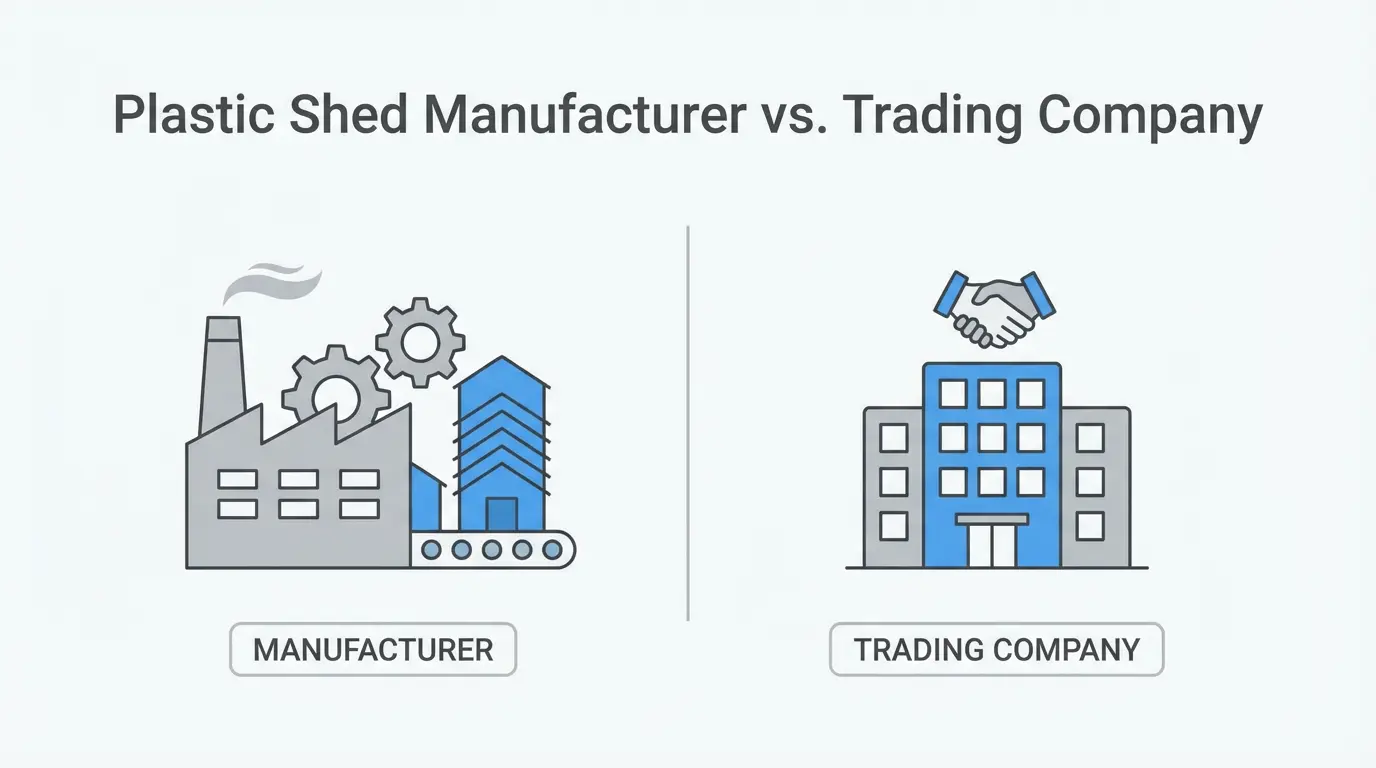
When sourcing plastic sheds for wholesale, OEM, or private-label business, buyers may meet plastic shed manufacturers or trading companies. So, it is important to understand the difference between a manufacturing company and a trading company. Knowing their differences helps entrepreneurs, investors, and customers make smarter decisions.
If you are thinking of importing from China you might have already been searching online looking for suppliers. What you may not be aware of is that many of the websites you have been visiting do not actually belong to manufacturers at all, but to trading companies. In this article, we’ll explain what the shed manufacturer and trading company are, and how they differ from each other, helping you make a informed decision.
Knowing the definition of the trading company and manufacturing company helps B2B buyers identify if the websites you find belong to manufacturers.
A typical trading company focuses on buying and selling products. Instead of producing products independently themselves, trading companies buy finished products from different manufacturers or suppliers, and sell those products to B2B buyers like private-owned brands, wholesalers, and retailers, or direct to consumers.
A typical manufacturing company produces its own products in house. It uses raw materials, and its own labor and machinery to create products and then these products are sold directly to B2B buyers or individual customers. The plastic shed manufacturer is a supplier that can independently manufacture and sell plastic shed from the start to the final step.
When sourcing plastic sheds for wholesale, OEM, or private-label projects, buyers may meet plastic shed manufacturers or trading companies. While both can supply products, they differ significantly in pricing, customization, quality control, and technical support.
Below, we break down the key differences to help you make an informed sourcing decision.
Plastic shed Manufacturers provide factory-direct pricing, eliminating the additional costs added by intermediaries. Their pricing is often related to labor, raw materials, and equipment maintenance, resulting in more transparent and competitive cost structures. In contrast, trading companies build pricing around sourcing fees, logistics coordination, and service margins, which typically leads to higher overall prices compared to working directly with a manufacturer.
When it comes to minimum order quantity (MOQ), trading companies usually have fixed and less flexible MOQs, as they rely on third-party factories. Plastic shed manufacturers, however, are more open to negotiating MOQs for long-term partnerships or large-volume orders, offering greater flexibility and more stable pricing over time.
Plastic shed manufacturers are usually equipped with specialized machinery and advanced production technology designed for mass production. The integration of automation, CAD-based design systems, and standardized production lines improves efficiency, accuracy, and consistency. As a result, manufacturers can offer a wide range of plastic shed models and delivers customized solutions that meet different customer needs.
In contrast, trading companies rely heavily on the third-party factories and manufacturers for production. This dependence requires careful factory selection to maintain quality standards. However, working across different third-party manufacturers can create challenges in maintaining product consistency, quality control, and long-term quality assurance.
When it comes to customization and OEM capabilities, manufacturers provide full OEM/ODM services, including custom sizes, panel thickness, materials, colors, structures, logo, and private-label packaging. With in-house engineering and production team, manufacturers can efficiently turn concepts into products.
Trading companies specialize in selling products, but rely on external factories to execute customization requests, which limits flexibility. As a result, design modifications often lead to higher costs and longer lead times.
Plastic shed manufacturers provide direct technical support backed by in-house engineering, production, and technical teams. This direct collaboration enables faster problem resolution and efficient product optimization, making manufacturers especially well suited for OEM projects and large-scale orders.
In contrast, trading companies may be limited in technical expertise, but often excel in customer communication and coordination, particular for international buyers. Trading companies help bridge language and communication gaps between overseas customers and factories.
| Aspect | Plastic Shed Manufacturer | Plastic Shed Trading Company |
| Production | In-house factory | Rely on third-party factory |
| Quality Control | Direct and stable control | Varies by factories |
| Customization | Full OEM/ODM capability | Limited customization |
| Pricing | Factory-direct pricing | Higher due to middleman margin |
| MOQ Flexibility | More flexible | Usually fixed |
| Certifications | Factory-owned | Often borrowed or shared |
| Lead Time | Predictable | Depends on factory |
| Technical Support | Good | Limited |
| After-sale Services | Moderate | Good |
| Risk Level | Lower for large orders | Higher for bulk sourcing |
Plastic shed manufacturers and trading companies have their own advantages, and the right choice depends on your business models, order volume, and long-term cooperation.
As a general guideline, choose a plastic shed manufacturer if you need OEM / ODM services, buy in bulk or long-term, or require stable quality. Choose the trading company if you need small trial orders or prioritize convenience over cost.
For businesses focused on brand building, cost efficiency, and long-term growth, working directly with a plastic shed manufacturer offers greater advantages in pricing, customization, quality consistency, and technical expertise.
Choosing between a plastic shed manufacturer and a trading company ultimately depends on your business goals. For B2B buyers focused on OEM/ODM development, cost efficiency, brand building, and reliable supply, partnering directly with a plastic shed manufacturer is the more strategic choice.
DiBiBi is a plastic shed manufacturer that not only specializes in producing plastic sheds, but also in other outdoor accessories.
Plastic shed manufacturers are the better choice for OEM or ODM plastic shed projects, as they support logo customization, packaging design, color matching, and structural modifications.
You can verify a manufacturer by browsing production photos or videos, certifications (ISO, BSCI, SGS) online, and sample inspections and factory visit offline.